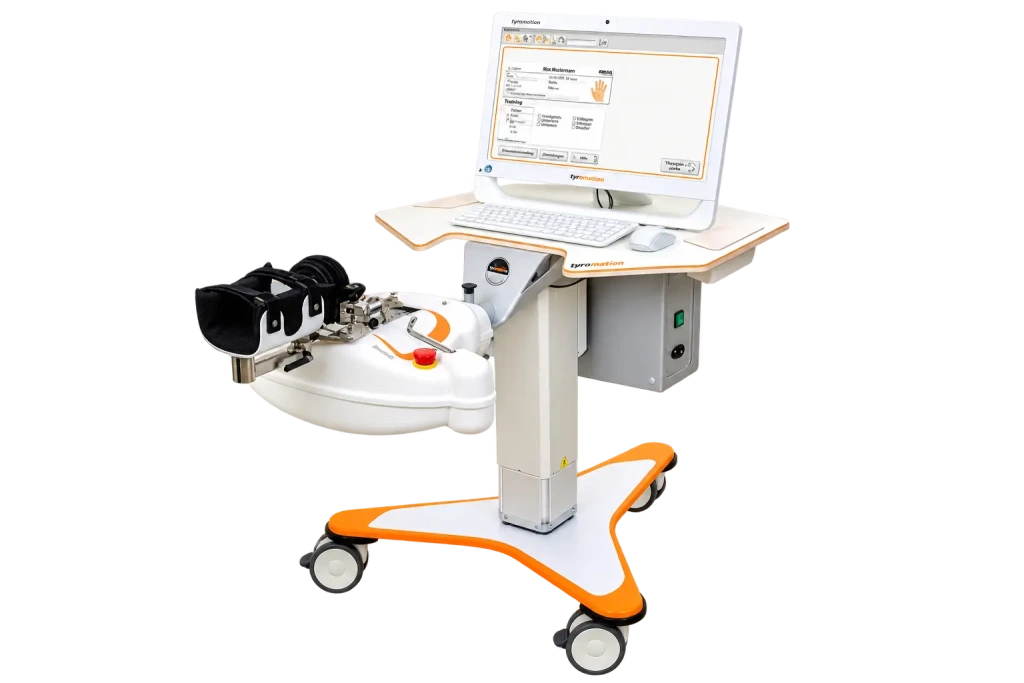
Amadeo is a robot-assisted rehabilitation system designed to provide intensive, repetitive, and individualized training for patients with impaired or limited hand and finger function. It is particularly developed for practicing functions such as finger opening and closing, grasping, and releasing.
After stroke, brain injury, spinal cord injury, and other neurological conditions, hand and finger movements may be significantly affected. Patients may have difficulty moving their fingers, opening the hand, grasping an object, or releasing a held object in a controlled manner.
Amadeo can be used at different stages of rehabilitation by offering passive, active-assisted, and active exercise modes according to the patient’s current functional capacity. The system can train all fingers together, but it can also target individual fingers or selected groups of fingers when needed.
By combining robotic assistance, interactive exercises, and real-time feedback, Amadeo aims to encourage the patient to participate as actively as possible while providing intensive practice of hand and finger movements.
What Is the Amadeo Robotic Rehabilitation System?
Amadeo is a robotic rehabilitation device specifically developed for hand and finger rehabilitation.
The patient’s fingertips are connected to dedicated attachments on the system. The robotic mechanism assists controlled opening and closing movements of the fingers and can provide different levels of support depending on the patient’s available motor capacity.
The system allows targeted training of:
-
All fingers together,
-
Individual fingers,
-
Selected groups of fingers,
-
The thumb.
This feature can be particularly useful in neurological conditions where individual fingers are affected to different degrees, allowing rehabilitation to be tailored more precisely.
The goal of Amadeo is not simply to move the hand robotically. As treatment progresses, the aim is to encourage voluntary movement, make use of the patient’s remaining muscle activity, and transition toward increasingly active exercise whenever possible.
How Does the Amadeo Robotic System Work?
Before treatment, the patient’s hand and finger function is evaluated.
The device is adjusted according to factors such as:
-
Joint range of motion,
-
Voluntary movement capacity,
-
Muscle strength,
-
Muscle tone,
-
Functional hand use.
The fingertips are then connected to the movable components of the robotic system, and an appropriate therapy mode is selected according to the rehabilitation goals.
Amadeo can be used to train:
-
Finger opening,
-
Finger closing,
-
Grasping,
-
Hand opening,
-
Individual finger movements,
-
Finger strength,
-
Range of motion,
-
Coordination.
As the patient’s motor capacity improves, therapy parameters can be adjusted to reduce robotic support and encourage greater use of the patient’s own movement.
What Are Passive, Active-Assisted, and Active Exercises?
One of the important features of Amadeo is its ability to provide therapy for patients at different functional levels.
Passive Exercise
In patients with very limited or absent voluntary finger movement, the robotic system can move the fingers through a controlled range of motion.
These exercises may be particularly useful during earlier stages of rehabilitation to provide regular joint movement and sensorimotor stimulation.
Active-Assisted Exercise
The patient attempts to perform the movement independently but may not generate enough strength to complete it.
In this situation, the robotic system can assist the movement to the degree required.
The aim is to prevent the patient from remaining completely passive and to encourage use of their own muscle activity whenever possible.
Active Exercise
In patients with sufficient voluntary movement, exercises can be performed using the patient’s own muscle activity.
The system detects the movement, monitors performance, and can transfer the movement into interactive computer-based rehabilitation tasks.
As the patient improves, rehabilitation may progress from passive exercise to active-assisted and then active exercise.
Why Is Individual Finger Training Important?
The hand is a highly complex functional structure.
In everyday activities, all fingers do not always perform the same movement.
For example, holding a small object may require precise control of the thumb and index finger, while holding a glass requires coordinated use of several fingers together.
After neurological injury, different fingers may also be affected to different degrees.
A patient may be able to move some fingers while having difficulty controlling others.
The ability to select and train individual fingers with Amadeo allows rehabilitation to focus on:
-
Specific affected fingers,
-
Independent finger movement,
-
Different grasp patterns,
-
Coordination between fingers.
This helps tailor hand rehabilitation more closely to the patient’s actual functional needs.
Rehabilitation of Grasping and Hand Opening
One of the most important functions of the hand in everyday life is the ability to grasp an object and release it in a controlled manner when needed.
After stroke and other neurological conditions, some patients may be able to close the hand but have difficulty reopening it. Others may not be able to generate sufficient grasp strength.
With Amadeo, movements such as:
-
Finger flexion,
-
Finger extension,
-
Grasping,
-
Hand opening,
-
Release after grasping,
-
Coordinated use of selected fingers
can be practiced repetitively.
These movement components are relevant to everyday activities such as holding a glass, using cutlery, picking up an object, operating a door handle, or performing personal care tasks.
Intensive and Repetitive Hand Rehabilitation
Regular and sufficiently high numbers of movement repetitions are important in neurological rehabilitation.
However, patients with significant weakness in the hand and fingers may have difficulty performing enough active repetitions during conventional exercise.
Robotic systems can help make movements more controlled and reproducible.
Within a single Amadeo session, the patient may perform repeated:
-
Finger opening,
-
Finger closing,
-
Grasping,
-
Releasing,
-
Individual finger movements.
The goal is not merely to increase the number of repetitions, but to perform them at a level appropriate to the patient’s capacity and with as much active participation as possible.
Why Is Active Patient Participation Important?
The purpose of robotic rehabilitation is not for the device to perform every movement for the patient.
Initiating movement, using remaining muscle activity, and participating actively are important components of rehabilitation.
For this reason, robotic assistance in Amadeo can be adjusted according to the patient’s functional level.
A patient with severe impairment may initially require greater assistance, while more active therapy modes can be introduced as voluntary movement improves.
This allows the rehabilitation program to progress gradually in line with the patient’s functional recovery.
EMG-Assisted Rehabilitation
In some patients, visible finger movement may not be present even though low-level electrical muscle activity occurs when they attempt to move.
In compatible configurations, surface electromyography (EMG) can help detect this muscle activity.
This may be useful in appropriately selected patients who have difficulty producing visible finger movement but still demonstrate detectable muscle activation.
The patient’s attempt to move can be detected and linked to exercises within the robotic system.
Whether EMG-assisted rehabilitation is appropriate is determined by the rehabilitation team according to the patient’s motor capacity and treatment goals.
Gamified and Interactive Exercises
Hand and finger rehabilitation often requires a high number of repetitions.
Repeating the same movements for long periods can become monotonous for some patients.
Computer-based interactive exercises available with Amadeo can make rehabilitation more engaging.
As the patient moves the fingers, the movement can control tasks displayed on the screen.
For example, the patient may be asked to:
-
Reach a specific target,
-
Move virtual objects,
-
Produce a specified level of finger force,
-
Perform movements at the correct time,
-
Complete selected tasks.
This transforms repetitive mechanical movements into more goal-directed exercises.
How Is Real-Time Feedback Used?
Amadeo can provide visual and auditory feedback about the patient’s performance.
During an exercise, the patient can see the result of the movement on the screen.
This feedback may provide information about:
-
Whether the movement was completed,
-
Whether the intended range of motion was reached,
-
The amount of force generated,
-
Success during the exercise.
Seeing the relationship between the performed movement and its outcome in real time can help make training more understandable and goal-oriented.
Training Hand and Finger Strength
Hand function depends not only on the ability to move the fingers but also on controlling force appropriately.
When the patient’s functional level allows, Amadeo can also be used for force-oriented exercises in addition to active finger movement training.
The goal is not simply to produce the strongest possible grip.
Different everyday activities require different levels of force. A delicate object may require low and precisely controlled force, while a heavier object may require greater force.
For this reason, the ability to generate and regulate force can also be an important functional rehabilitation goal.
Assessment of Spasticity and Muscle Tone
After central nervous system conditions such as stroke or brain injury, some patients may develop spasticity and increased muscle tone in the fingers.
This may contribute to:
-
The hand remaining in a clenched position,
-
Difficulty opening the fingers,
-
Difficulty releasing an object after grasping,
-
Problems with hand hygiene and care,
-
Reduced functional use of the hand.
Amadeo provides measurement options that may help assess certain parameters related to finger range of motion and muscle tone.
Spasticity should not be assessed solely on the basis of device measurements. Clinical examination remains essential when planning treatment.
Objective Measurement and Performance Monitoring
One of the important advantages of technology-assisted rehabilitation is the ability to monitor performance using measurable parameters.
With Amadeo, parameters related to hand and finger function may include:
-
Range of motion,
-
Force,
-
Measurements related to muscle tone,
-
Exercise performance,
-
Active movement capacity.
Measurements obtained at the beginning of treatment can be compared with later assessments.
These data do not replace clinical examination, but they can provide additional information to help the rehabilitation team monitor progress more objectively and adjust the treatment program.
Who May Be Suitable for Amadeo?
Amadeo may be used as part of a comprehensive rehabilitation program in patients whose hand and finger functions are affected for different reasons.
Hand and Finger Impairment After Stroke
Following stroke, weakness, loss of movement, impaired coordination, or spasticity may develop in the hand and fingers on one side of the body.
The patient may have difficulty opening the hand, controlling the fingers, or grasping and releasing objects.
In appropriately selected patients, Amadeo can support intensive and controlled practice of these movements.
Traumatic and Other Brain Injuries
Traumatic and other acquired brain injuries may affect arm and hand function to varying degrees.
Depending on the patient’s motor capacity, passive, active-assisted, or active hand and finger exercises may be incorporated into rehabilitation.
Spinal Cord Injury
Hand and finger function may be affected particularly after cervical spinal cord injuries.
In patients with sufficient preserved muscle activity and appropriate functional potential, robotic hand and finger rehabilitation may be included in the treatment program.
Multiple Sclerosis and Other Neurological Conditions
Multiple Sclerosis and other neurological conditions affecting hand function may cause changes in finger movement, strength, coordination, and fine motor control.
When clinically appropriate, technology-assisted hand rehabilitation may be used as part of a comprehensive treatment program.
Rehabilitation After Hand and Finger Injuries
The use of robotic rehabilitation following hand or finger injuries depends on the type of injury, stage of healing, surgical restrictions, and the ability of the tissues to tolerate movement and loading.
Particularly after orthopedic injury or surgery, the timing of treatment should be determined by the relevant physician.
How Is Amadeo Treatment Planned?
Before Amadeo treatment begins, hand and finger function is assessed in detail.
The assessment may include:
-
Active finger movement,
-
Passive joint range of motion,
-
Hand and finger strength,
-
Muscle tone and spasticity,
-
Sensory function,
-
Grasping and releasing ability,
-
Functional use of the hand in activities of daily living,
-
Individual rehabilitation goals.
The device is then adjusted according to the patient’s hand dimensions and functional capacity.
Passive or active-assisted therapy may initially be used in patients who require greater robotic support.
As the patient improves, rehabilitation may progress through:
passive exercise → active-assisted exercise → active movement → strength- and function-oriented exercise
The rate of progression varies between patients.
Session duration, frequency, and exercise difficulty are therefore individualized.
What Are the Advantages of the Amadeo Robotic Rehabilitation Approach?
Individualized Hand and Finger Rehabilitation
Because every patient is affected differently, therapy parameters can be adjusted according to individual needs.
The ability to train all fingers together or individually allows more personalized exercise programs to be developed.
Therapy for Different Functional Levels
Passive, active-assisted, and active exercise options make it possible to provide training for patients with different levels of motor impairment.
Intensive and Repetitive Exercise
The robotic system allows hand and finger movements to be repeated many times in a controlled manner.
Supporting Active Participation
As function improves, robotic support can be reduced to encourage greater use of the patient’s own muscle activity.
Individual Finger Training
The ability to isolate selected fingers allows treatment to focus more precisely on the patient’s functional needs.
Grasping and Hand-Opening Training
The system supports repetitive practice of grasping, releasing, and hand-opening movements that are important in everyday life.
Interactive Exercises
Gamified applications and real-time feedback can make treatment more engaging and support active participation.
Objective Performance Monitoring
Monitoring parameters such as range of motion, force, and exercise performance helps support more objective evaluation of rehabilitation progress.
Supporting Activities of Daily Living with Amadeo
The ultimate goal of hand rehabilitation is not simply for the patient to move the fingers while connected to the device.
The broader objective is to support transfer of these gains into activities of daily living.
Hand and finger function is required for activities such as:
-
Eating,
-
Holding a glass,
-
Using a fork and spoon,
-
Dressing,
-
Fastening buttons,
-
Using a phone,
-
Holding a pen,
-
Opening a door,
-
Performing personal care.
For this reason, Amadeo exercises may be combined with occupational therapy, physiotherapy, and functional hand training using real objects.
The aim is to support the transfer of movement capacity gained during device-based rehabilitation into practical use in everyday life.
Is Amadeo Sufficient as a Stand-Alone Treatment?
No.
Amadeo is used as part of a comprehensive hand and upper extremity rehabilitation program.
Depending on the patient’s needs, robotic hand rehabilitation may be combined with:
-
Individual physiotherapy,
-
Occupational therapy,
-
Upper extremity rehabilitation,
-
Functional hand exercises,
-
Sensory training,
-
Muscle strengthening,
-
Range-of-motion exercises,
-
Functional Electrical Stimulation,
-
Activities of daily living training.
Robotic rehabilitation can provide intensive and repeatable exercise, but a comprehensive approach is important for transferring these gains into real-world function.
Is Amadeo Suitable for Every Patient?
No.
Although Amadeo may be used in patients with different degrees of hand and finger impairment, it is not appropriate for everyone.
Before treatment, the following should be assessed:
-
Joint range of motion of the hand and fingers,
-
Muscle and tendon condition,
-
Degree of spasticity,
-
Pain,
-
Skin integrity,
-
Healing status following fracture or surgery,
-
Sensory function,
-
Overall medical condition.
Suitability for robotic hand rehabilitation and selection of the appropriate therapy mode are determined by the physician and rehabilitation team.
What Is the Main Goal of Rehabilitation with Amadeo?
The primary goal of Amadeo rehabilitation is not simply to move the patient’s fingers with robotic assistance.
The broader aim is to identify and make use of the patient’s remaining hand and finger function, encourage active participation, and support improvement of opening, closing, grasping, releasing, force control, and independent finger movements through intensive and controlled training.
As function improves, the level of robotic support and exercise difficulty can be adjusted.
This allows rehabilitation to progress from passive movement toward increasingly active and functional use of the hand.
Frequently Asked Questions About Amadeo Robotic Rehabilitation
Does Amadeo only move the hand passively?
No. In addition to passive exercise, Amadeo provides active-assisted and active exercise options. The therapy mode is selected according to the patient’s current motor capacity.
Can Amadeo train individual fingers?
Yes. In addition to moving all fingers together, the system allows selected fingers to be targeted individually.
Can Amadeo be used in patients who have difficulty opening the hand?
In appropriately selected patients, it may be used to provide controlled training of finger extension and hand-opening movements. Suitability is determined through individual assessment.
Can Amadeo be used after stroke?
Yes. In appropriately selected patients with impaired hand and finger function after stroke, Amadeo may be included as part of a comprehensive upper extremity rehabilitation program.
Can Amadeo be used in patients with spasticity?
It may be used in some patients with spasticity or increased muscle tone. However, the degree of spasticity, joint range of motion, pain, and overall clinical condition should be evaluated before treatment.
Does the patient actively participate during Amadeo treatment?
Yes, when functional capacity allows. The system can provide active-assisted or active exercise according to the patient’s movement ability.
Does Amadeo restore normal hand function?
The same outcome cannot be guaranteed for every patient. Robotic rehabilitation can support intensive practice of hand and finger movements, but transferring improvements into everyday activities usually requires integration with functional exercises, occupational therapy, and other rehabilitation approaches.
How long does Amadeo treatment take?
There is no standard treatment duration. Session length and frequency depend on the diagnosis, severity of hand impairment, rehabilitation goals, and the patient’s response to treatment.