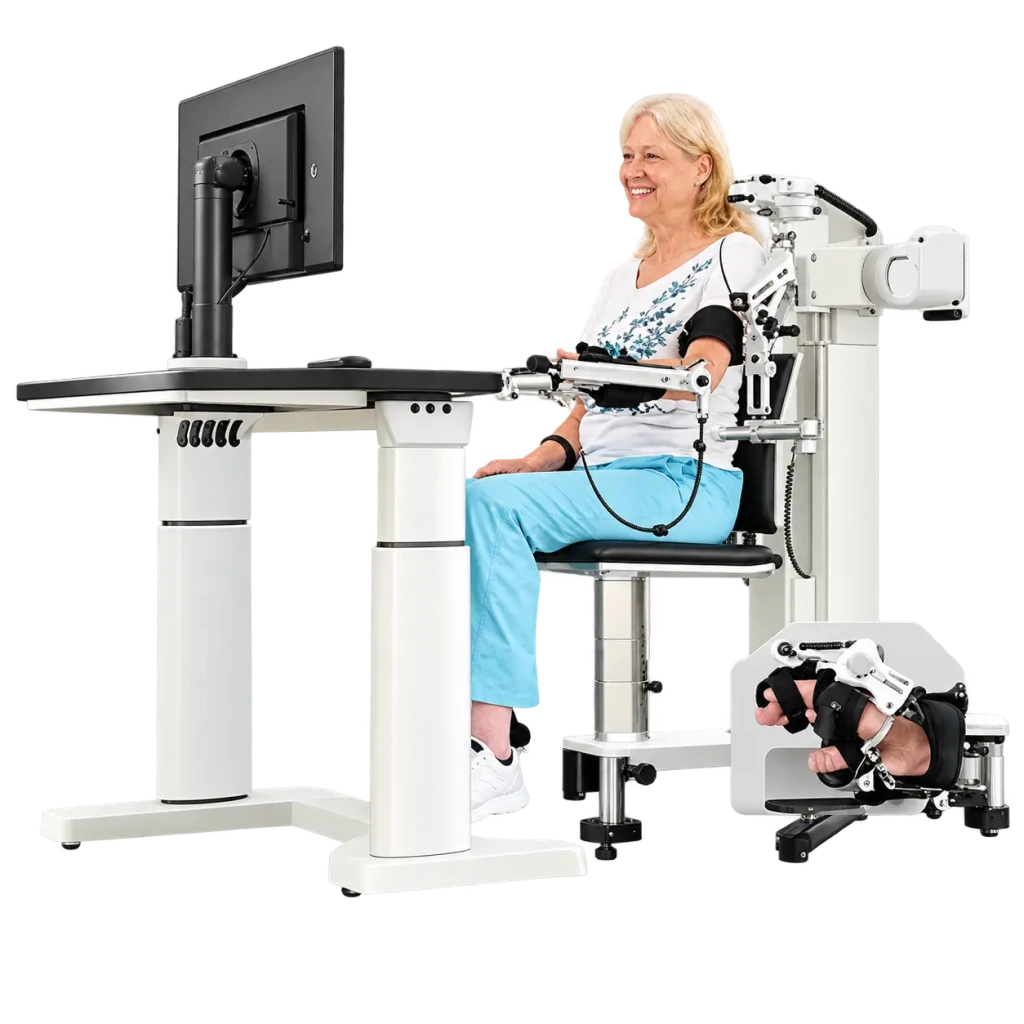
ArmeoSpring is an advanced rehabilitation system designed to support upper extremity rehabilitation in patients whose arm and hand functions have been affected by neurological conditions or injuries. It enables intensive and repetitive training of movements involving the shoulder, elbow, forearm, wrist, and hand.
One of the system’s key features is its adjustable spring-based arm-weight support mechanism. By supporting part of the weight of the arm, the system allows patients who have difficulty moving their arm against gravity to use their remaining muscle strength and exercise through a wider range of motion.
ArmeoSpring does more than provide mechanical support. Integrated sensors detect the patient’s movements and transfer them to interactive computer-based exercises. As the patient moves the arm, they complete tasks displayed on the screen and receive real-time feedback on their performance.
This allows high-repetition training, active patient participation, visual feedback, and objective performance monitoring to be combined within the rehabilitation process.
The primary goal of ArmeoSpring rehabilitation is not to move the patient’s arm passively, but to make the best possible use of the patient’s existing motor capacity and support improvement of upper extremity function from the shoulder to the hand.
What Is ArmeoSpring?
ArmeoSpring is a sensor-equipped rehabilitation system with adjustable arm-weight support, developed to assist functional arm and hand exercises in patients with mild to moderate upper extremity impairment.
The mechanical orthosis is adjusted to the patient’s arm and supports the upper extremity from the shoulder to the forearm. Its spring mechanism compensates for part of the arm’s weight, making movements against gravity easier to perform.
The amount of support can be adjusted according to the patient’s current muscle strength and functional capacity.
For example, a patient who can lift the arm only to a very limited degree may initially require greater weight support. As motor capacity improves, the amount of support can be reduced, encouraging the patient to use their own muscles more actively.
The fundamental principle of ArmeoSpring is not to move for the patient, but to facilitate the movement the patient is already capable of performing and increase the number of active repetitions.
How Does ArmeoSpring Work?
During ArmeoSpring treatment, the patient is generally positioned in a seated position.
The upper extremity orthosis is adjusted according to the patient’s arm length, joint alignment, and body dimensions.
The level of arm-weight support is then selected according to the patient’s current movement capacity.
When the patient moves the arm, sensors within the system detect these movements and transfer them in real time to interactive rehabilitation applications on a computer screen.
For example, when the patient:
- Reaches forward,
- Raises the arm,
- Moves the arm to the right or left,
- Flexes or extends the elbow,
- Rotates the forearm,
- Moves the wrist,
the corresponding virtual task on the screen responds to the movement.
This allows rehabilitation to move beyond repeatedly exercising a single joint and instead focuses on completing goal-directed tasks.
Exercise difficulty, range of motion, visual characteristics, and duration can all be adjusted according to the patient’s capacity.
How Does ArmeoSpring Arm-Weight Support Work?
One of the major challenges in upper extremity rehabilitation is difficulty moving the arm against gravity.
Following stroke or brain injury, a patient may still be able to generate some voluntary movement, but the available muscle strength may not be sufficient to support the full weight of the arm.
For example, a patient may be able to move the arm while lying down or when the arm is supported, but may be unable to lift it from a table while sitting.
ArmeoSpring’s spring mechanism supports part of the weight of the arm and reduces the load created by gravity.
This allows the patient’s remaining muscle strength to be used more effectively and may enable movements to be practiced through a wider range than would otherwise be possible.
As treatment progresses and motor control improves, the amount of weight support can be gradually reduced.
The goal is for the patient to increasingly control the arm using their own muscle activity.
Why Is Active Participation Important with ArmeoSpring?
An important feature of ArmeoSpring rehabilitation is that the patient is expected to take an active role during exercise.
The system does not automatically move the arm using motors.
Instead, it supports the weight of the arm so that the patient can make better use of their existing motor ability.
To complete a task on the screen, the patient must initiate and control the movement as much as possible.
This approach supports two important principles of neurorehabilitation: active movement and intensive repetition.
The appropriate amount of support is important.
Too little support may make the movement impossible to perform, while too much support may make the exercise unnecessarily easy.
For this reason, arm-weight support and exercise difficulty are adjusted by the rehabilitation team according to the patient’s performance.
Three-Dimensional Arm Movements with ArmeoSpring
Arm movements in everyday life do not occur in only one direction.
Activities such as picking up a glass, combing the hair, reaching into a cabinet, or moving an object across a table require coordinated movement of the shoulder, elbow, forearm, wrist, and hand.
ArmeoSpring allows training to progress from isolated joint movements to more complex two- and three-dimensional functional movements.
Depending on the patient’s functional level, treatment may begin with simpler movements focused on individual joints.
Examples include:
- Elbow flexion and extension,
- Shoulder flexion,
- Horizontal shoulder movements.
As motor control improves, more complex activities requiring coordinated movement of multiple joints can be introduced.
At this stage, the patient may be asked to reach toward targets at different heights and directions, follow moving objects, or complete specific computer-based tasks.
Upper Extremity Training from Shoulder to Hand
ArmeoSpring is not designed solely for shoulder or elbow rehabilitation.
The system allows the upper extremity movement chain to be assessed and trained as a whole.
Exercises may involve:
- Forward and backward shoulder movement,
- Internal and external shoulder rotation,
- Horizontal shoulder movements,
- Elbow flexion and extension,
- Forearm pronation and supination,
- Wrist movements,
- Tasks involving grasping.
This is particularly important for rehabilitation of multi-joint movements required during activities of daily living.
Can Hand Function Be Trained with ArmeoSpring?
Upper extremity rehabilitation involves not only reaching toward an object but also grasping, holding, and releasing it.
ArmeoSpring can detect grasp-related movements and may allow arm and hand functions to be trained within the same exercise.
In compatible system configurations, the ManovoSpring hand module may provide mechanical assistance for hand opening.
This can allow the patient to perform sequential tasks such as:
- Reaching toward a virtual object,
- Grasping it,
- Moving it to another location,
- Releasing it.
The exercise therefore goes beyond simply moving the arm from one point to another and can incorporate combined functions such as reaching and grasping that are important in daily life.
Why Is Repetitive Exercise Important with ArmeoSpring?
Upper extremity rehabilitation following neurological injury often requires a high number of movement repetitions.
However, patients with significant arm weakness may struggle to achieve sufficient repetition during conventional exercises because of difficulty moving against gravity.
By supporting part of the arm’s weight, ArmeoSpring may help patients perform a larger number of active repetitions within their current capacity.
Different tasks within the system also allow similar movement patterns to be practiced in various ways.
This increases exercise variety while helping the patient remain actively engaged in rehabilitation.
How Are Interactive Exercises Used with ArmeoSpring?
ArmeoSpring uses computer-based, game-like interactive exercises.
These applications are not designed solely for entertainment. Each task can be configured to train a specific movement or function.
For example, the patient may be asked to:
- Reach toward a specific target,
- Follow a moving object,
- Move objects to designated locations,
- Perform controlled arm movements in different directions,
- Reach a specified number of targets within a certain period.
As the patient performs the task, they can see the result of their movement on the screen in real time.
This provides augmented performance feedback, helping the patient recognize the relationship between the movement performed and the outcome achieved.
Real-Time Feedback with ArmeoSpring
Seeing the result of a movement is an important component of motor learning during rehabilitation.
ArmeoSpring detects movement through sensors and transfers it to the computer environment.
The patient can see a virtual object move in response to their own arm movement and receive immediate feedback about whether the task was completed successfully.
This allows the patient to see:
- Whether the target was reached,
- How controlled the movement was,
- Whether the exercise was completed successfully.
The feedback also helps the rehabilitation team evaluate performance.
Motivation During ArmeoSpring Treatment
Long-term rehabilitation often involves performing similar movements repeatedly, which may reduce motivation in some patients.
Interactive ArmeoSpring tasks can transform repetitive exercises into a more goal-oriented rehabilitation environment.
Instead of simply being asked to “raise the arm 20 times,” the patient may attempt to reach a target or complete a task on the screen.
The ability to adjust exercise difficulty and provide immediate performance feedback may help support continued participation.
As the patient improves, new and more challenging goals can be introduced.
Who May Be Suitable for ArmeoSpring?
ArmeoSpring may be particularly suitable for patients with mild to moderate upper extremity impairment who retain some active arm movement but have difficulty moving against gravity or performing functional movements.
Suitability is determined after assessment by a Physical Medicine and Rehabilitation physician.
Stroke
Weakness on one side of the body after stroke can significantly affect arm and hand function.
Patients may have difficulty:
- Raising the shoulder,
- Controlling the elbow,
- Reaching toward an object,
- Using the hand during daily activities.
In appropriately selected patients, ArmeoSpring can support the weight of the arm and facilitate intensive, repetitive training of active upper extremity movements.
Traumatic Brain Injury
Brain injury caused by traffic accidents, falls, or other trauma may affect upper limb strength, coordination, and motor control.
When the patient has sufficient active movement capacity, ArmeoSpring may be incorporated into the rehabilitation program to provide intensive arm and hand training.
Anoxic Brain Injury
Anoxic brain injury resulting from prolonged lack of oxygen to the brain may cause varying degrees of motor impairment.
In appropriately selected patients with upper extremity dysfunction, ArmeoSpring may be used as part of a comprehensive neurorehabilitation program.
Spinal Cord Injury
Depending on the level and severity of spinal cord injury, arm and hand function may be affected to varying degrees.
In patients who retain active upper extremity movement, ArmeoSpring may be used to provide controlled and repetitive training of arm and hand movements.
Other Neurological Conditions
In other neurological disorders affecting upper extremity movement, ArmeoSpring may be considered after evaluation of:
- Muscle strength,
- Coordination,
- Joint range of motion,
- Overall functional capacity.
Treatment decisions should be based not only on the diagnosis but also on the patient’s current functional abilities and rehabilitation goals.
How Is ArmeoSpring Treatment Planned?
Before ArmeoSpring treatment, upper extremity function is assessed in detail.
The evaluation may include:
- Shoulder movement,
- Elbow movement,
- Forearm control,
- Wrist movement,
- Grasping capacity,
- Muscle strength,
- Joint range of motion,
- Muscle tone,
- Coordination,
- Active movement capacity,
- Functional performance in activities of daily living.
The device is then adjusted according to the patient’s anatomical dimensions.
The amount of arm-weight support and exercise range are selected according to current functional capacity.
Early sessions may involve easier tasks and greater arm support.
As function improves:
- Weight support may be reduced,
- Range of movement may be increased,
- Exercise difficulty may be progressed.
Treatment can therefore be delivered as an individualized upper extremity rehabilitation program that progresses according to the patient’s improvement, rather than as a fixed protocol.
Objective Assessment and Data Monitoring with ArmeoSpring
One of the important features of ArmeoSpring is its ability to measure patient movement using integrated sensors.
The system can monitor different joints and movements from the shoulder to the hand and record performance data obtained during rehabilitation.
Parameters that may be monitored include:
- Changes in range of motion,
- Coordination,
- Reaction time,
- Exercise performance,
- Success during specific tasks.
Assessments performed at different stages of treatment can be compared to monitor progress more objectively.
These data may also help the rehabilitation team determine future goals and adjust exercise difficulty.
What Are the Goals of ArmeoSpring Treatment?
Treatment goals vary according to the patient’s current functional capacity.
ArmeoSpring rehabilitation may aim to support:
- Increased active arm movement,
- Improved shoulder and elbow control,
- Training of upper extremity range of motion,
- Improved arm and hand coordination,
- A greater number of active repetitions,
- Three-dimensional reaching movements,
- Functional movements such as reaching and grasping,
- More controlled movement,
- Greater active participation in rehabilitation,
- Practice of movements used in daily activities.
Goals are individualized.
For one patient, the primary goal may be to lift the arm from a table, while another may focus on holding a cup, reaching toward an object, or performing more refined hand movements.
What Are the Advantages of ArmeoSpring?
Individualized Arm-Weight Support
ArmeoSpring’s spring-based mechanism compensates for part of the weight of the patient’s arm.
The amount of support can be adjusted according to need, allowing the patient to participate actively using their own muscle strength.
Greater Opportunity for Active Movement
Reducing the effect of gravity may allow patients with limited muscle strength to practice movements that would otherwise be difficult to perform.
This can help increase the number of active movement repetitions achieved during rehabilitation.
Wide Three-Dimensional Range of Motion
ArmeoSpring is not limited to movement in a single plane.
Patients can use the shoulder, elbow, forearm, wrist, and hand to move toward targets at different heights and directions.
This allows training of multidirectional upper extremity movements commonly used in everyday life.
Combined Arm and Hand Training
The system supports rehabilitation of the movement chain extending from the shoulder to the hand.
Functions that are frequently combined in daily life, such as reaching and grasping, may be trained within the same exercise.
Interactive Exercise Environment
Computer-based tasks and visual feedback make the rehabilitation program more interactive.
Patients can see the result of their movement on the screen and work toward specific exercise goals.
Objective Performance Monitoring
Sensor-based performance data can be used to monitor changes over time.
These data may help the rehabilitation team adjust the program according to the patient’s performance and progress.
Encouraging Active Participation
ArmeoSpring does not passively move the patient’s arm.
The patient performs the movement using their own muscle activity, while the system provides only the level of arm-weight support required.
Active participation therefore remains central to the rehabilitation process.
How Does ArmeoSpring Relate to Activities of Daily Living?
The ultimate goal of upper extremity rehabilitation is not simply to improve joint range of motion.
The goal is to help the patient use the arm and hand as functionally as possible during everyday activities.
Activities such as:
- Eating,
- Lifting a glass,
- Washing the face,
- Combing the hair,
- Dressing,
- Reaching toward an object on a table,
- Grasping and moving an object
require coordinated movement of multiple joints from the shoulder to the hand.
ArmeoSpring exercises can provide intensive practice of movement components underlying these activities, including multidirectional reaching, controlled movement, and grasp-related tasks.
The rehabilitation team may combine ArmeoSpring with functional physiotherapy and occupational therapy to help transfer improvements achieved during device-based training into real-world daily activities.
Is ArmeoSpring Suitable for Every Patient?
No.
Although ArmeoSpring may be used in a variety of neurological conditions, it is not appropriate for every patient.
It is primarily intended for functional training in patients with mild to moderate upper extremity impairment.
Before treatment, the following should be evaluated:
- Active movement capacity,
- Muscle strength,
- Joint range of motion,
- Muscle tone,
- Shoulder and upper limb structure,
- Pain,
- Cognitive capacity,
- Ability to follow visual feedback,
- Overall medical condition.
Suitability for ArmeoSpring treatment is determined after evaluation by a Physical Medicine and Rehabilitation physician.
Is ArmeoSpring Sufficient as a Stand-Alone Treatment?
No.
ArmeoSpring is used as part of a comprehensive upper extremity rehabilitation program and does not replace the entire treatment process.
Depending on the patient’s needs, ArmeoSpring may be combined with:
- Individual physiotherapy,
- Occupational therapy,
- Hand rehabilitation,
- Muscle strengthening exercises,
- Range-of-motion exercises,
- Functional Electrical Stimulation,
- Activities of daily living training,
- Other robotic and technology-assisted rehabilitation approaches.
One of the important advantages of technology-assisted rehabilitation is the ability to provide intensive and repeatable exercise.
However, transferring gains achieved with the device into real-world activities remains an essential part of comprehensive rehabilitation.
What Is the Goal of Rehabilitation with ArmeoSpring?
The primary goal of ArmeoSpring rehabilitation is not simply to help the patient move the arm more while using the device.
The broader goal is to make the best possible use of the patient’s remaining muscle activity to support more controlled, coordinated, and functional arm and hand movements and improve the effective use of the upper extremity in activities of daily living.
As the patient progresses:
- Arm-weight support can be reduced,
- The exercise workspace can be expanded,
- More complex tasks can be introduced.
Treatment can therefore progress from simple single-joint movements toward three-dimensional reaching, grasping, and more functional activities related to daily life.
At Acıbadem Healthcare Group, ArmeoSpring upper extremity rehabilitation is planned as part of a comprehensive, individualized treatment program after assessment of the patient’s medical condition, current arm and hand function, and rehabilitation goals.
Through advanced rehabilitation technologies and a multidisciplinary approach, the aim is to support improvement in upper extremity function and help patients achieve the highest possible level of independence in daily life.