Lokomat Pro is an advanced robot-assisted gait rehabilitation system designed to support the recovery and improvement of walking function in patients with reduced or lost walking ability. It may be used as part of an individualized rehabilitation program, particularly for gait disorders that develop after stroke, brain injury, spinal cord injury, and other neurological conditions.
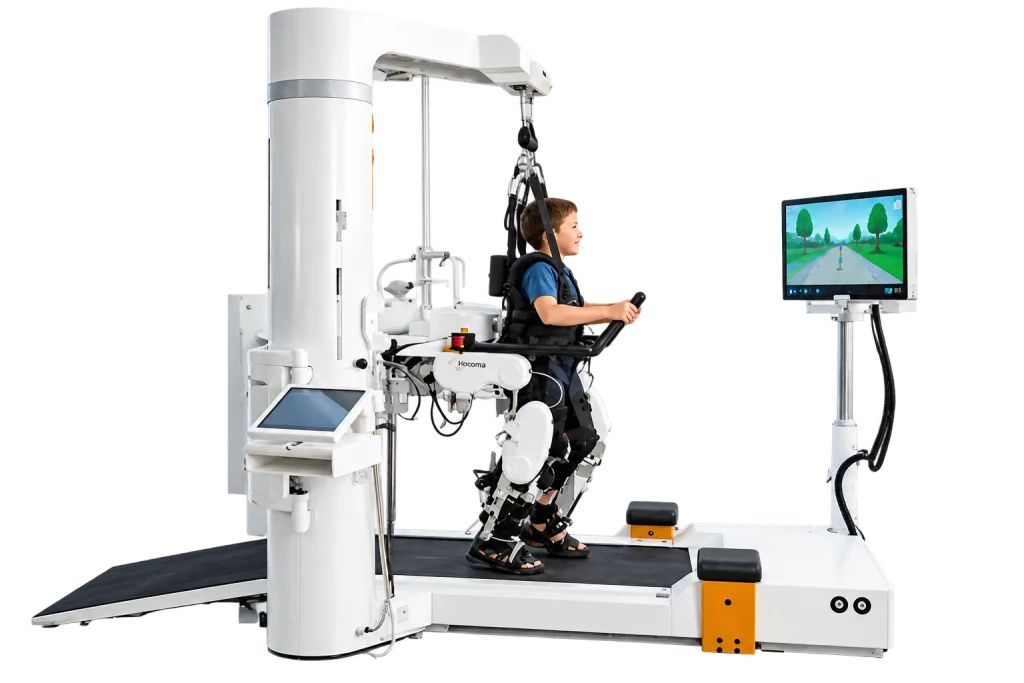
The system combines a robotic gait orthosis, treadmill, dynamic body-weight support, and interactive rehabilitation applications that monitor the patient’s performance. While the robotic system provides controlled assistance to the hip and knee joints, the patient performs repetitive stepping exercises on the treadmill.
The primary goal of Lokomat Pro is not to move the patient passively, but to provide the level of assistance needed according to the patient’s existing motor capacity and enable intensive, repetitive, and individualized gait training. As the patient’s functional abilities improve, robotic assistance can be gradually reduced to encourage more active participation.
For this reason, Lokomat Pro is one of the important robotic rehabilitation technologies used in neurorehabilitation to support gait pattern development, lower limb movement, and progress toward greater functional independence.
What Is the Lokomat Pro Robotic Gait Rehabilitation System?
Lokomat Pro is a rehabilitation system that provides robot-assisted, task-specific gait training for patients who have lost the ability to walk or who experience significant difficulty walking.
The system includes a robotic gait orthosis that can be adjusted to fit the patient’s legs. Robotic motors assist movement of the hip and knee joints while the patient performs controlled stepping exercises on a treadmill.
During treatment, part of the patient’s body weight can be supported by the system. This means that patients who are not yet able to fully support their own body weight may still be able to participate in gait training after an appropriate clinical assessment.
Depending on the patient’s progress, the following parameters can be individually adjusted:
- Body-weight support,
- Walking speed,
- Hip and knee range of motion,
- Level of robotic guidance and assistance,
- Exercise difficulty.
These features allow Lokomat Pro to be adapted to patients with different functional abilities.
How Does Lokomat Pro Work?
During Lokomat Pro treatment, the patient is positioned over the treadmill using a specialized harness system. The robotic gait orthosis is then adjusted to fit the patient’s legs and aligned with the hip and knee joints.
Once treatment begins, the treadmill moves while the robotic orthosis guides the legs through a controlled gait pattern. The body-weight support system helps the patient practice stepping in a safer and more controlled environment.
Treatment does not simply involve the device moving the patient’s legs.
The level of robotic assistance can be adjusted according to the patient’s existing motor abilities. As the patient becomes increasingly able to generate the movement independently, the amount of assistance can be reduced to encourage greater active participation.
This allows patients to perform a high number of regular and controlled step repetitions during rehabilitation.
For complex motor functions such as walking, task-specific and repetitive training is an important principle of neurorehabilitation. Lokomat Pro supports structured and repeatable gait practice and may help increase the intensity of the rehabilitation program.
How Does the Lokomat Pro Treatment Process Work?
Before Lokomat Pro treatment, the patient is evaluated by a Physical Medicine and Rehabilitation physician and the rehabilitation team.
The assessment may include:
- Muscle strength,
- Joint range of motion,
- Muscle tone,
- Trunk control,
- Lower limb motor capacity,
- Balance,
- Current walking ability,
- Cardiovascular condition,
- Associated medical conditions,
- Overall rehabilitation goals.
If the patient is considered suitable for robotic gait rehabilitation, the system is adjusted according to body measurements and functional capacity.
During the first sessions, the patient may require greater body-weight support or a higher level of robotic guidance.
As treatment progresses and active participation improves, these levels can be gradually modified.
For example, the robotic system may initially provide substantial assistance with stepping, while later sessions may require the patient to generate more of the movement independently.
In this way, the rehabilitation program can become progressively more challenging as the patient improves.
Because every patient has a different diagnosis, functional level, and recovery process, Lokomat Pro session duration and frequency are not standardized.
The program is planned individually according to the patient’s needs, tolerance, and rehabilitation goals.
What Is Dynamic Body-Weight Support?
One of the important features of Lokomat Pro is its dynamic body-weight support system.
During walking, the lower limbs normally support the body’s weight. However, patients with severe neurological impairment may initially be unable to safely support their full body weight.
The Lokomat Pro support system can partially unload the patient’s body weight, helping regulate the amount of load placed on the legs according to individual capacity.
This may allow patients to begin gait-related movement training before they are able to stand and walk completely independently.
As muscle strength, balance, and weight-bearing capacity improve, the level of support may be gradually reduced.
The goal is to encourage the patient to support more of their own body weight and participate more actively in gait training.
How Is Robotic Assistance Adjusted in Lokomat Pro?
One of the main advantages of Lokomat Pro is that the level of robotic support can be adjusted according to the patient’s functional capacity.
A patient with very limited voluntary movement during the early stages of rehabilitation may require more robotic assistance.
As muscle control and movement capacity improve, assistance can be reduced.
This approach follows the principle of “as much assistance as needed.”
The goal is not to have the robot move the patient completely passively, but to encourage the patient to use their own muscles and participate actively whenever possible.
Adjusting robotic assistance according to performance allows the treatment program to progress in parallel with functional improvement.
Why Is Repetitive Gait Training Important?
Walking is a complex function that requires coordinated activity between the brain, spinal cord, peripheral nerves, muscles, joints, balance systems, and sensory feedback mechanisms.
Neurological conditions such as stroke or brain injury can disrupt this coordination.
A patient may have difficulty advancing one leg, controlling the knee, maintaining balance, or may develop an asymmetrical gait pattern.
In neurorehabilitation, regular and repetitive practice of appropriate movement patterns is important for supporting motor relearning and functional recovery.
Lokomat Pro allows patients to perform a large number of controlled step repetitions within a rehabilitation session.
Increasing active patient participation during these repetitions is one of the key goals of treatment.
Who May Be Suitable for Lokomat Pro?
Lokomat Pro may be used in the rehabilitation of various neurological conditions that affect walking.
Suitability depends less on the diagnosis alone and more on the patient’s current functional condition, medical stability, and rehabilitation goals.
Stroke
After stroke, gait may be affected by muscle weakness, balance problems, coordination difficulties, and loss of movement on one side of the body.
In appropriate patients, Lokomat Pro can support intensive and repetitive gait practice.
Body-weight support and robotic assistance can be adjusted progressively according to the patient’s improvement.
Traumatic Brain Injury
Brain injury following traffic accidents, falls, or other trauma may affect balance, coordination, motor control, and walking.
Lokomat Pro may be incorporated into neurorehabilitation to support repetitive and controlled stepping practice in appropriately selected patients.
Spinal Cord Injury
Depending on the neurological level and severity of spinal cord injury, varying degrees of motor impairment may occur in the lower limbs.
In selected patients with gait potential, robot-assisted gait training may be used as part of rehabilitation to provide intensive and controlled lower limb movement practice.
Multiple Sclerosis (MS)
People with Multiple Sclerosis may experience changes in muscle strength, balance, coordination, and walking capacity.
When clinically appropriate, robot-assisted gait training may be included in a comprehensive rehabilitation program to support walking function.
Other Neurological Gait Disorders
Patients with Parkinson’s disease or other neurological disorders affecting walking may also benefit from selected robotic rehabilitation approaches depending on individual assessment.
Suitability for Lokomat Pro treatment is determined after detailed evaluation by a Physical Medicine and Rehabilitation physician.
What Are the Goals of Lokomat Pro Treatment?
Treatment goals vary according to each patient’s functional condition.
Lokomat Pro may be used to support:
- Intensive and repetitive gait practice,
- Lower limb coordination,
- Improvement of gait pattern,
- Increased active participation during exercise,
- Controlled loading through the legs,
- Gradual reduction of robotic assistance,
- Endurance and functional mobility,
- Rehabilitation goals related to greater independence.
Goals are individualized according to the diagnosis, severity of impairment, time since injury or illness, and current functional capacity.
What Are the Key Features of the Lokomat Pro Robotic Gait System?
Individualized Gait Training
Lokomat Pro allows adjustment of:
- Hip and knee range of motion,
- Walking speed,
- Body-weight support,
- Level of robotic assistance.
This makes it possible to create a gait training program suited to the patient’s current abilities and rehabilitation goals.
Support for a More Physiological Gait Pattern
The robotic gait orthosis guides the hip and knee joints within a predefined movement pattern during walking.
The goal is to help the patient practice within a more controlled gait pattern rather than relying excessively on compensatory or poorly coordinated movements.
Intensive and Repetitive Exercise
Lokomat Pro allows a large number of step repetitions within a single treatment session.
The robotic system helps maintain movement within predefined parameters, supporting the intensive practice often required in neurological rehabilitation.
Encouraging Active Participation
Robotic assistance can be adjusted according to the patient’s needs.
As movement capacity improves, assistance can be reduced so that the patient uses their own muscles to a greater extent.
The aim is therefore not passive movement, but active participation whenever possible.
Dynamic Body-Weight Support
The system can support part of the patient’s body weight during walking.
This can help patients who are not yet able to bear full weight or walk safely and independently participate in controlled gait training.
Support for Pelvic Movement
The FreeD feature of Lokomat Pro allows selected natural pelvic movements during gait training.
Including pelvic movement can help create a more functional training environment, recognizing that walking involves more than simply moving the legs forward and backward.
Interactive and Motivating Exercises
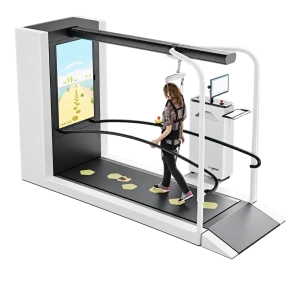
Lokomat Pro provides interactive exercise options using visual and auditory feedback to encourage active participation.
Patients may complete tasks displayed on a screen and receive immediate feedback on their performance.
This feedback is designed to encourage greater effort and engagement during rehabilitation.
Real-Time Performance Feedback
The system allows various aspects of patient activity to be monitored during treatment.
The rehabilitation team can assess how actively the patient is participating and how exercises are being performed, then modify treatment parameters as needed.
Objective Data Monitoring
One of the advantages of robotic rehabilitation is the ability to monitor selected performance parameters numerically.
These data may help the rehabilitation team evaluate progress and adjust the program in subsequent sessions.
Why Is Motivation Important During Lokomat Pro Treatment?
Neurological rehabilitation often requires long-term treatment and a high number of repetitions.
For this reason, maintaining active patient participation is important.
Interactive applications available with Lokomat Pro can help transform gait training from purely repetitive mechanical stepping into a more engaging task-based rehabilitation experience.
Visual and auditory feedback allow the patient to follow their performance during the session and attempt to reach specific movement goals.
This can help make rehabilitation more interactive and encourage the patient to play a more active role in treatment.
Is Lokomat Pro Suitable for Every Patient?
No.
Although Lokomat Pro is an advanced rehabilitation system that can be used in many neurological conditions, it is not appropriate for every patient.
Before treatment, the following should be evaluated:
- Overall medical condition,
- Bone and joint health,
- Joint range of motion,
- Muscle tone,
- Cardiovascular status,
- Skin integrity,
- Height and body dimensions,
- Associated injuries or medical conditions.
Suitability for robotic gait rehabilitation and the appropriate timing of treatment are determined by a Physical Medicine and Rehabilitation physician.
Is Lokomat Pro Sufficient as a Stand-Alone Treatment?
No.
Robot-assisted gait systems may be an important part of comprehensive neurorehabilitation, but they do not replace the entire rehabilitation program.
Depending on the patient’s needs, Lokomat Pro may be combined with:
- Individual physiotherapy,
- Balance and coordination training,
- Muscle strengthening,
- Trunk control exercises,
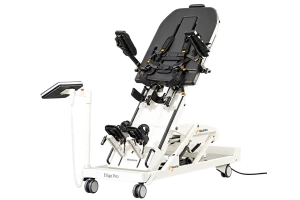
- Standing and transfer training,
- Upper limb rehabilitation,
- Occupational therapy,
- Speech and swallowing therapy,
- Other robotic rehabilitation technologies.
The potential benefit of robotic rehabilitation should therefore be evaluated within the context of the patient’s overall rehabilitation program.
What Is the Goal of Rehabilitation with Lokomat Pro?
The primary goal of Lokomat Pro rehabilitation is not simply to enable the patient to walk while connected to the device.
The broader goal is to help the patient use their existing motor capacity to practice appropriate gait movements intensively and repetitively, participate actively in rehabilitation, and progress toward the highest possible level of functional independence.
As the patient improves, robotic assistance may be gradually reduced and treatment may progress to:
- Parallel bar training,
- Balance exercises,
- Assisted walking,
- Overground gait training,
- Independent walking practice when appropriate.
For this reason, Lokomat Pro should be viewed not merely as an exercise performed inside a robotic device, but as one component of a comprehensive neurorehabilitation program aimed at restoring and improving walking function.
At Acıbadem Healthcare Group, Lokomat Pro robot-assisted gait rehabilitation is planned as part of an individualized rehabilitation program following detailed assessment of the patient’s medical condition and functional capacity.
Through advanced robotic technologies, an experienced rehabilitation team, and a multidisciplinary approach, the goal is to improve mobility and help patients achieve the highest possible level of independence in daily life.