ErigoPro Robotic Tilt Table
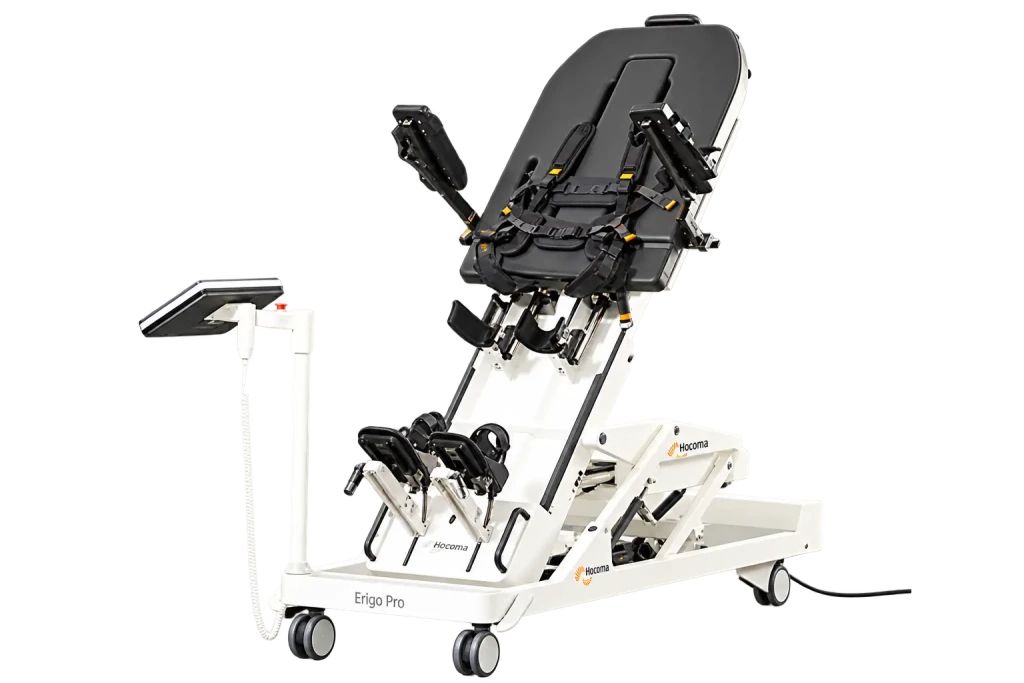
The ErigoPro robotic tilt table is an advanced rehabilitation system designed to support early mobilization in patients with severely reduced mobility, those who are not yet able to stand, or patients who require mobilization support following prolonged bed rest. It may be used particularly after neurological conditions, severe brain or spinal cord injuries, intensive care stays, or prolonged immobility to help prepare patients for an upright position.
ErigoPro combines gradual verticalization, robotic leg movement, and cyclic leg loading within a single system. In appropriate patients, Functional Electrical Stimulation (FES) may also be integrated into treatment to stimulate selected leg muscles during movement.
Prolonged immobility can lead to reduced muscle strength, limited joint range of motion, and difficulty adapting to an upright position. For this reason, controlled mobilization can be an important component of rehabilitation from the early stages, particularly in patients with severe neurological impairment.
ErigoPro gradually brings the patient into an upright position at individually selected angles while simultaneously providing repetitive leg movements. This allows patients who are not yet able to stand or walk independently to participate in a controlled mobilization program.
What Is ErigoPro?
ErigoPro is a robot-assisted rehabilitation system used for the early mobilization and gradual verticalization of patients who are bed-dependent, unable to stand, or have severely reduced standing ability.
While conventional tilt-table therapy primarily aims to move the patient from a horizontal to an upright position, ErigoPro adds robotic leg movement and controlled cyclic loading of the lower limbs to this process.
During treatment, parameters such as the tilt angle, leg range of motion, level of robotic assistance, and amount of loading applied to the legs can be adjusted according to the patient’s condition.
This enables treatment to be individualized according to the patient’s tolerance and rehabilitation goals.
ErigoPro can be particularly useful during the early stages of rehabilitation, when active exercises may not yet be possible, helping prepare the patient for later stages such as sitting, standing, balance training, and gait rehabilitation.
How Does ErigoPro Work?
ErigoPro treatment begins with the patient being safely positioned on the device.
Initially, the patient remains in a horizontal or near-horizontal position. During the session, the inclination of the device is gradually increased in a controlled manner to bring the patient toward an upright position.
At the same time, the robotic system produces repetitive leg movements according to a predetermined movement pattern.
Cyclic loading is also applied through the lower limbs, with the aim of providing sensory input similar to the loading that occurs during standing and walking.
Treatment is generally based on the combined use of:
- Gradual verticalization: Supports controlled progression from a horizontal to an upright position.
- Robotic leg movement: Provides regular and repetitive lower limb movement.
- Cyclic leg loading: Applies rhythmic and controlled loading through the lower limbs.
- Sensorimotor stimulation: Provides sensory input to the muscles, joints, and nervous system through movement and loading.
- Functional Electrical Stimulation (FES): In suitable patients, selected muscle groups can be electrically stimulated in synchronization with robotic movement.
These features allow mobilization, lower limb movement, loading, and sensorimotor stimulation to be combined within the same treatment session.
Why Is ErigoPro Used?
Prolonged immobility can make rehabilitation more difficult, particularly after severe neurological conditions.
When a patient remains in bed for an extended period, changes may occur in the musculoskeletal and cardiovascular systems. Some patients may also experience low blood pressure, dizziness, or difficulty tolerating an upright position when mobilization begins again.
ErigoPro helps create a gradual and controlled mobilization process rather than moving the patient directly into full upright standing.
The main goals of ErigoPro treatment may include:
- Supporting safe and controlled early mobilization,
- Gradually increasing tolerance to an upright position,
- Providing repetitive lower limb movement,
- Helping reduce the negative effects of prolonged immobility on muscles and joints,
- Supporting circulation and venous return,
- Providing sensorimotor stimulation to the lower limbs,
- Preparing the patient for later rehabilitation stages such as sitting, standing, transfers, and gait training.
For this reason, ErigoPro is one of the robotic rehabilitation technologies that may be used during the early rehabilitation period when independent movement is not yet possible.
The Role of ErigoPro in Early Rehabilitation
After severe neurological conditions such as stroke, traumatic brain injury, or spinal cord injury, some patients may initially be unable to sit, stand, or voluntarily move their legs.
However, rehabilitation does not need to wait until the patient can walk independently.
When the patient’s medical condition allows, controlled mobilization can be incorporated into the rehabilitation program from an early stage.
One of the key features of ErigoPro is that it allows rehabilitation to begin even in patients with very limited active movement capacity.
Through repetitive robotic leg movement and gradual verticalization, mobilization can be performed according to the patient’s tolerance.
As the patient’s functional abilities improve, the rehabilitation program can progress toward more active exercise, balance training, standing practice, transfers, and, where appropriate, robot-assisted gait training.
ErigoPro should therefore not be considered a stand-alone walking treatment. It is better viewed as one of the early steps in the rehabilitation pathway from initial mobilization toward more advanced functional training.
Which Conditions Can ErigoPro Be Used For?
ErigoPro may be incorporated into rehabilitation programs for patients with severely reduced mobility following neurological, traumatic, or selected surgical conditions.
Common areas of use include:
Stroke
After a stroke, patients may develop severe weakness or loss of movement affecting one side of the body or multiple limbs.
In patients who are not yet able to stand independently, ErigoPro may be used to provide controlled verticalization and robot-assisted lower limb movement.
The goal is to support early mobilization and prepare the patient for subsequent stages of rehabilitation.
Traumatic Brain Injury
Severe brain injury following a traffic accident, fall, or other trauma may cause varying degrees of impairment in consciousness, balance, muscle control, and mobility.
ErigoPro allows controlled verticalization and repetitive lower limb movement even in appropriately selected patients with limited active participation.
This may support early sensorimotor stimulation and mobilization.
Spinal Cord Injury
Depending on the level and severity of spinal cord injury, patients may experience partial or severe loss of movement in the legs.
In appropriately selected patients who cannot stand independently, ErigoPro can provide robotic lower limb movement while gradually bringing the patient into an upright position.
These interventions may be incorporated into rehabilitation to support joint mobility, muscle activation, and adaptation to an upright position.
Post-Intensive Care Rehabilitation
Patients who have spent prolonged periods in intensive care may develop significant muscle weakness and reduced functional capacity due to immobility.
Basic activities such as turning in bed, sitting, or standing may become difficult.
In medically stable patients who are considered suitable by the rehabilitation team, ErigoPro may help initiate the remobilization process in a controlled manner.
Prolonged Bed Rest
Patients who remain in bed for extended periods following surgery, trauma, or illness may experience reduced muscle strength and physical capacity.
ErigoPro may be used in selected patients to support remobilization through gradual verticalization and repetitive lower limb movement.
Other Neurological Conditions
ErigoPro may also be considered in other neurological conditions that significantly impair mobility, depending on the patient’s clinical condition and rehabilitation needs.
Suitability for robotic rehabilitation is determined after assessment by a Physical Medicine and Rehabilitation physician.
ErigoPro and Functional Electrical Stimulation (FES)
One of the important features of ErigoPro is the ability to combine robotic lower limb movement with Functional Electrical Stimulation (FES) in appropriately selected patients.
FES applies controlled electrical impulses to selected muscle groups to support muscle contraction.
In the ErigoPro system, electrical stimulation can be synchronized with robotic leg movements.
This allows treatment to combine mechanical movement with targeted muscle activation.
The intensity of FES and other treatment parameters are adjusted by healthcare professionals according to the patient’s clinical condition, tolerance, and rehabilitation goals.
FES is not required for every patient and is used only when considered appropriate following individual assessment.
What Are the Advantages of ErigoPro?
One of the main advantages of ErigoPro is that it enables patients who are not yet able to stand independently to participate in a controlled mobilization program.
Gradual and Controlled Verticalization
Rather than moving directly into an upright position, the patient can be progressively tilted to different angles.
The degree of verticalization can be adjusted according to the patient’s response and tolerance.
Repetitive Robot-Assisted Movement
ErigoPro provides regular and reproducible leg movements.
This is particularly useful in patients with very limited voluntary movement.
Support for Circulation
Robotic leg movements and, when appropriate, muscle contractions induced by FES may help activate the lower limb muscle pump and support venous return.
Support for Muscles and Joints
Regular lower limb movement can support rehabilitation goals related to maintaining joint range of motion and stimulating the musculoskeletal system after prolonged immobility.
Sensorimotor Stimulation
Movement, cyclic loading, and changes in body position provide repeated sensory input to the nervous system.
This sensorimotor stimulation can be an important component of a neurorehabilitation program.
Individualized Treatment
Parameters such as:
- Tilt angle,
- Range of motion,
- Level of robotic assistance,
- Leg loading,
- FES settings when used
can be adjusted according to the patient’s individual needs.
Intensive and Reproducible Rehabilitation
The robotic system enables controlled and repeatable movement patterns, helping rehabilitation sessions to be delivered in a structured and measurable way.
How Is ErigoPro Treatment Performed?
Before ErigoPro treatment begins, the patient’s medical and functional condition is evaluated by a Physical Medicine and Rehabilitation physician and the rehabilitation team.
Assessment may include:
- Blood pressure,
- Cardiovascular status,
- Respiratory function,
- Joint range of motion,
- Muscle tone,
- Level of consciousness and communication,
- Mobility,
- Associated medical conditions.
After the patient is safely positioned on the device, treatment usually begins at a low tilt angle.
The angle can then be gradually increased according to the patient’s tolerance.
Robotic treatment parameters such as:
- Range of motion,
- Movement pattern,
- Level of assistance,
- Leg loading,
- Treatment duration,
- FES parameters when used
can be individually adjusted.
The patient’s clinical condition is monitored throughout the session.
Treatment duration and frequency are not the same for every patient. They are determined according to the underlying condition, general medical status, rehabilitation goals, and response to treatment.
Is ErigoPro Suitable for Every Patient?
No. Although ErigoPro can be used in a wide range of clinical conditions, it is not suitable for every patient.
Before treatment, factors such as:
- Cardiovascular condition,
- Bone and joint health,
- Skin integrity,
- Muscle tone,
- Associated injuries,
- Overall medical stability
must be evaluated.
For this reason, patients should be assessed by a Physical Medicine and Rehabilitation physician before ErigoPro treatment to determine whether robotic mobilization is appropriate.
Robotic rehabilitation devices should be used as part of a comprehensive and individualized rehabilitation program rather than as stand-alone treatments.
What Is the Goal of ErigoPro Treatment?
The primary goal of ErigoPro is not to make the patient walk immediately.
Its main purpose is to support mobilization at the earliest safe and clinically appropriate stage in patients with severely reduced mobility.
Depending on the patient’s condition, treatment may aim to:
- Improve tolerance to an upright position,
- Provide regular lower limb movement,
- Increase sensorimotor stimulation,
- Support muscle and joint function,
- Help reduce the negative effects of prolonged immobility,
- Prepare the patient for more active rehabilitation.
As functional capacity improves, the rehabilitation program can progress to include:
- Sitting and trunk control,
- Active exercise,
- Transfer training,
- Balance training,
- Standing practice,
- Robot-assisted or supported gait training when appropriate.
For this reason, ErigoPro may be considered one of the technologies that helps bridge the transition from early mobilization to more advanced functional rehabilitation.