Lokomat Pro Pediatric is an advanced robot-assisted rehabilitation system designed to provide intensive, controlled, and repetitive gait training for children whose walking function has been affected by neurological or orthopedic conditions.
With pediatric gait orthoses, harnesses, and support systems specifically designed for children, the device can be adjusted according to the child’s body dimensions and current functional capacity. During walking, hip and knee movements are supported by the robotic system, while part of the child’s body weight can be supported through the harness system when needed.
This allows appropriately selected children who are not yet able to walk independently for prolonged periods or who require assistance during walking to perform a high number of controlled step repetitions in a safe rehabilitation environment.
Lokomat Pro Pediatric may be used as part of a comprehensive pediatric rehabilitation program, particularly in children with cerebral palsy, traumatic brain injury, spinal cord injury, and other neurological conditions affecting walking function.
The primary goal of Lokomat Pro Pediatric is not simply to move the child’s legs passively. The level of robotic assistance can be adjusted according to the child’s functional capacity, and active participation is encouraged whenever possible.
As the child’s movement capacity improves, robotic assistance and body-weight support can be modified to progressively advance the rehabilitation program.
What Is Lokomat Pro Pediatric?
Lokomat Pro Pediatric is a robot-assisted gait rehabilitation system specifically designed for children.
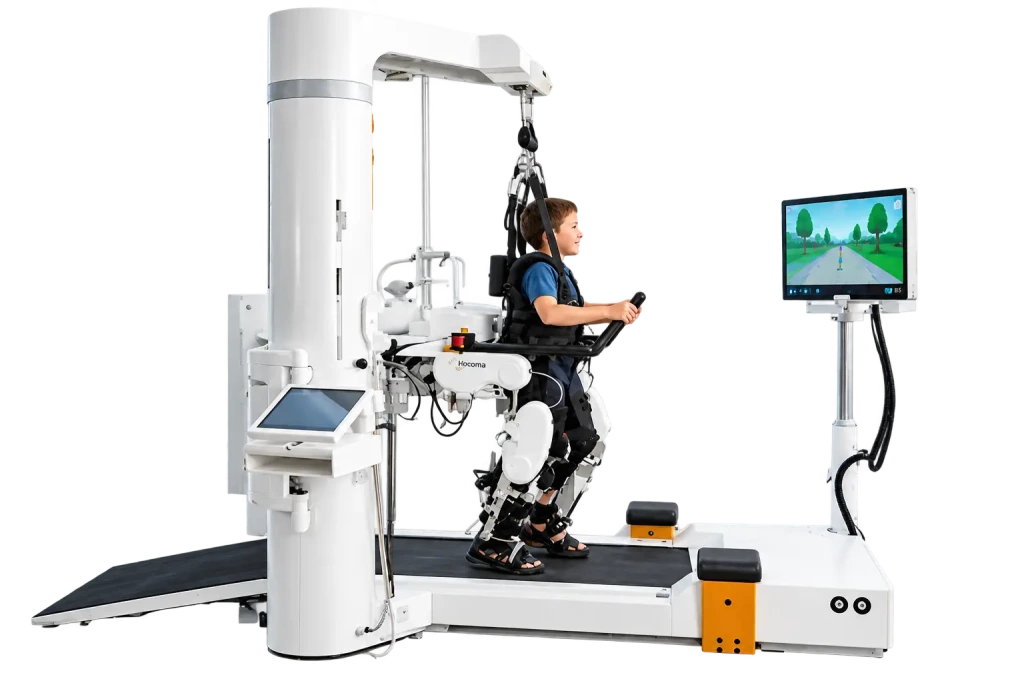
During treatment, the child is supported by a harness system and positioned over a treadmill. Robotic orthoses fitted to the legs assist the hip and knee joints through a predefined gait pattern.
The pediatric configuration includes specially designed:
- Gait orthoses,
- Cuffs,
- Harness systems,
- Connection and support components.
The pediatric orthoses can be adjusted according to the child’s leg length, allowing individualized gait training for children with different body dimensions.
Lokomat Pro Pediatric is not simply a mechanical support system. Walking speed, robotic assistance, range of motion, and body-weight support can all be adjusted according to the child’s current capacity.
This allows rehabilitation to be tailored to individual needs rather than applied in the same way to every child.
How Does Lokomat Pro Pediatric Work?
At the beginning of treatment, the child is safely secured in the harness system and the robotic orthoses are adjusted to fit the legs.
Correct anatomical alignment of the robotic system with the hip and knee joints is important. The level of body-weight support and robotic assistance is then determined according to the child’s current walking ability.
When the treadmill begins to move, the robotic orthoses guide the child’s legs through a movement pattern consistent with the gait cycle.
During treatment:
- Walking speed can be adjusted according to the child’s capacity.
- Hip and knee range of motion can be individualized.
- Robotic assistance can be increased or decreased.
- A portion of body weight can be supported by the harness system.
- Active participation can be monitored.
- Exercise difficulty can be modified according to progress.
- Performance data may be reviewed to help plan subsequent sessions.
This allows the child to perform a high number of regular and controlled gait cycles within a structured rehabilitation environment.
Why Is Body-Weight Support Used in Children?
An important part of gait training is the ability to support body weight through the legs.
However, some children with cerebral palsy, brain injury, or other neurological conditions may not be able to support their full body weight adequately during certain stages of rehabilitation.
In these situations, Lokomat Pro’s body-weight support system may be used.
The harness system supports part of the child’s body weight, reducing the load that must be carried through the legs.
This allows the child to participate in gait training under conditions appropriate to their current muscle strength and functional capacity.
As strength, endurance, and walking capacity improve, the level of support can be adjusted.
The goal, whenever possible, is to help the child progressively bear more of their own body weight and participate more actively in walking.
How Is Robotic Assistance Adjusted for Each Child?
One of the key features of Lokomat Pro Pediatric is that robotic assistance is not fixed.
Some children may require greater assistance to complete the stepping movement, while others may be able to generate a substantial portion of the movement themselves.
The level of robotic support can therefore be adjusted according to the child’s capacity.
At the beginning of treatment, a child who requires more help may receive a higher level of robotic assistance.
As the child begins to perform more of the movement actively, the amount of assistance can be reduced.
The aim is not for the device to perform the entire movement for the child, but to provide only the level of support needed while encouraging as much active movement as possible.
This allows rehabilitation to become progressively more active as the child develops.
What Is the Goal of Robotic Gait Training in Children?
The purpose of pediatric robotic gait rehabilitation is not simply to have the child take steps while using the device.
Treatment may aim to support:
- Intensive and repetitive gait practice,
- A more physiological gait pattern,
- Improved coordination of hip and knee movements,
- Controlled loading through the lower limbs,
- Muscle activation,
- Greater active participation during walking,
- Improved walking endurance,
- Progressive reduction in the level of assistance required,
- Functional goals related to greater mobility and independence.
Rehabilitation goals differ from child to child.
For one child, the goal may be to walk longer with support. For another, the priority may be improving step symmetry, increasing walking speed, or walking more safely with an assistive device.
For this reason, goals are determined primarily according to the child’s current functional capacity rather than diagnosis alone.
Why Is Intensive and Repetitive Gait Training Important in Children?
Walking is a complex motor skill that requires coordinated activity of the brain, spinal cord, nerves, muscles, joints, sensory systems, and balance mechanisms.
Neurological conditions may affect coordination between these systems to varying degrees.
Regular and repetitive practice is an important component of motor learning and neurorehabilitation.
However, in children with significant gait impairment, achieving a high number of steps with consistent movement quality using conventional methods alone may be physically challenging.
Lokomat Pro Pediatric can provide robotic assistance and body-weight support, allowing a high number of controlled step repetitions within a therapy session.
An important goal is to perform these repetitions with as much active participation from the child as possible.
Individualized Robotic Rehabilitation
Every child has a different neurological condition, muscle strength, muscle tone, joint range of motion, balance capacity, and walking ability.
For this reason, Lokomat Pro Pediatric uses an individualized rehabilitation approach rather than a standardized program.
Treatment parameters that may be adjusted include:
- Walking speed,
- Level of robotic assistance,
- Body-weight support,
- Hip and knee range of motion,
- Exercise duration,
- Exercise difficulty,
- Visual and auditory feedback.
For example, a child receiving a high level of robotic assistance at the beginning of treatment may gradually require less support as function improves.
Similarly, exercises initially performed at lower speeds or with greater body-weight support can be modified over time.
This allows rehabilitation to progress in parallel with the child’s development.
Why Is Active Participation Important?
One of the key principles of robot-assisted gait rehabilitation is to avoid having the child remain completely passive.
Lokomat Pro Pediatric can be adjusted to allow the child to use their existing motor capacity.
As movement ability improves, robotic assistance can be reduced so that the child performs a greater proportion of the gait cycle using their own muscle activity.
For this reason, the rehabilitation team evaluates not only how long the child walks, but also how actively the child participates in the exercise.
Encouraging active participation helps make robotic rehabilitation more functional and goal-directed.
Supporting Motivation with Gamified Exercises
Motivation is an important part of pediatric rehabilitation.
Long-term and intensive rehabilitation programs can sometimes become tiring or repetitive for children.
Visual, auditory, and game-like interactive exercises used with Lokomat Pro Pediatric are designed to make gait training more engaging.
While walking, the child may control characters or tasks on a screen through their movements.
For example, the child may be asked to:
- Reach specific targets,
- Guide a character on the screen,
- Complete selected tasks,
- Collect points according to walking performance.
This encourages the child to move toward a goal rather than focusing only on repetitive mechanical stepping.
These applications may support more active participation in rehabilitation.
Real-Time Feedback and Performance Monitoring
Lokomat Pro Pediatric allows various performance parameters related to the child’s participation to be monitored during rehabilitation.
Visual feedback allows the child to see the result of their movement on the screen.
The rehabilitation team can evaluate performance and adjust:
- Robotic assistance,
- Walking speed,
- Body-weight support,
- Exercise difficulty.
Comparing data obtained at different stages of treatment may also help monitor progress more objectively.
Which Conditions Can Lokomat Pro Pediatric Be Used For?
Lokomat Pro Pediatric may be considered as part of a comprehensive rehabilitation program for children whose gait is impaired for different reasons.
Cerebral Palsy
Children with cerebral palsy may experience varying degrees of impairment in:
- Muscle tone,
- Motor control,
- Balance,
- Coordination,
- Walking.
In appropriately selected children, Lokomat Pro Pediatric can support physiotherapy by providing controlled and high-repetition gait training.
Treatment goals are determined according to the child’s current functional level.
Traumatic Brain Injury
Brain injury caused by traffic accidents, falls, or other trauma may affect muscle strength, coordination, balance, and walking in children.
Robot-assisted gait training may help appropriately selected children practice walking movements in a controlled and repetitive manner.
Spinal Cord Injury
Depending on the level and severity of spinal cord injury, lower limb function may be affected to different degrees.
In children with gait potential who are considered suitable after medical assessment, Lokomat Pro Pediatric may be incorporated into rehabilitation to train lower limb movement and gait patterns.
Other Neurological Conditions
Robot-assisted gait rehabilitation may also be considered in other neurological conditions affecting walking, depending on the child’s individual clinical status.
Treatment decisions are not based solely on the name of the diagnosis. Movement capacity, medical condition, and rehabilitation goals are considered together.
Gait Rehabilitation After Orthopedic Conditions
Some orthopedic injuries or surgical procedures may temporarily affect gait pattern and lower limb function.
Depending on weight-bearing and movement restrictions determined by the surgeon and rehabilitation physician, technology-assisted gait training may be incorporated at appropriate stages of recovery.
Who Is Suitable for Lokomat Pro Pediatric?
Suitability for Lokomat Pro Pediatric is not determined only by age or diagnosis.
Before treatment, the following may be evaluated:
- Height and leg length,
- Body weight,
- Joint range of motion,
- Muscle strength,
- Muscle tone and degree of spasticity,
- Hip and knee structure,
- Bone health,
- Cardiovascular and respiratory status,
- Skin integrity,
- Cognitive and communication abilities,
- Rehabilitation goals.
The Physical Medicine and Rehabilitation physician and rehabilitation team determine whether robotic gait training is safe and appropriate.
Can the System Be Adjusted as the Child Grows?
Yes.
The pediatric orthoses used with Lokomat Pro are designed to accommodate the body dimensions of smaller children.
The specialized orthoses, cuffs, and harness systems can be adjusted according to the child’s measurements.
For this reason, suitability is not assessed solely according to chronological age. Leg length, body weight, and whether the orthoses can be fitted correctly are particularly important.
As the child grows or physical characteristics change during rehabilitation, system settings can be readjusted.
Advantages of Lokomat Pro Pediatric Robotic Gait Training
Intensive and Repetitive Gait Training
The robotic system allows a high number of controlled gait cycles to be performed.
Individualized Robotic Assistance
The level of robotic support can be increased or decreased according to the child’s motor capacity.
Body-Weight Support
In appropriately selected children who cannot yet fully support their body weight, the system can help provide more controlled gait training.
Support for a Physiological Gait Pattern
The system allows hip and knee movements to be practiced within a predefined gait pattern.
Encouraging Active Participation
As the child improves, robotic assistance can be reduced to encourage greater use of their own muscles.
Interactive Rehabilitation
Game-like exercises and visual-auditory feedback can make rehabilitation more engaging for children.
Objective Performance Monitoring
Performance data collected during treatment may help monitor progress and guide adjustments to the rehabilitation program.
Progression According to the Child’s Development
Parameters such as walking speed, robotic assistance, and body-weight support can be modified throughout rehabilitation.
How Does Lokomat Pro Pediatric Relate to Daily Life?
The ultimate goal of robotic gait rehabilitation is not simply to help the child walk better while using the device.
The broader objective is to support transfer of motor gains into everyday functional mobility.
Children may need to:
- Move around the home,
- Navigate the school environment,
- Participate in play,
- Join family and social activities,
- Move independently or with assistive devices.
For this reason, Lokomat Pro Pediatric can be combined with individualized physiotherapy, balance training, strengthening exercises, and functional gait training according to the child’s everyday goals.
Is Lokomat Pro Pediatric Sufficient as a Stand-Alone Treatment?
No.
Robot-assisted gait training is one component of a comprehensive pediatric rehabilitation program.
Depending on the child’s needs, Lokomat Pro Pediatric may be combined with:
- Individual physiotherapy,
- Muscle strengthening,
- Balance and coordination training,
- Trunk control exercises,
- Stretching and range-of-motion exercises,
- Functional gait training,
- Occupational therapy,
- Activities of daily living training,
- Other robotic rehabilitation technologies.
The robotic system can provide controlled and intensive repetition, while functional training is essential for transferring these gains into everyday life.
Next-Generation Technology in Pediatric Robotic Rehabilitation
Robotic systems used in pediatric rehabilitation are designed to complement rather than replace conventional physiotherapy.
Lokomat Pro Pediatric combines a robotic gait orthosis, body-weight support, customizable therapy parameters, and interactive feedback systems to provide intensive gait training in a controlled environment.
The foundation of rehabilitation is not the technology itself, but the child’s individual needs and functional goals.
Technology is used as a tool to provide high-repetition training, objective monitoring, and adjustable support in pursuit of these goals.
Frequently Asked Questions About Lokomat Pro Pediatric
From what age can Lokomat Pro Pediatric be used?
There is no fixed minimum age based solely on chronological age.
Suitability is determined according to the child’s body dimensions and clinical condition.
The pediatric orthoses are designed for children with a femur length of approximately 21–35 cm. Body weight, correct fit of the harness system, joint range of motion, and overall medical condition are also evaluated.
The rehabilitation team determines whether treatment is appropriate.
Is Lokomat Pro Pediatric used only for children with cerebral palsy?
No.
In addition to cerebral palsy, it may be used following specialist assessment in children with traumatic brain injury, spinal cord injury, and other neurological conditions affecting walking.
Treatment decisions are based on the child’s current functional capacity and rehabilitation goals rather than diagnosis alone.
Does robot-assisted gait training replace conventional physiotherapy?
No.
Lokomat Pro Pediatric is used as part of a comprehensive rehabilitation program.
While robotic gait training allows intensive and repetitive stepping practice, individual physiotherapy, strengthening, balance, coordination, and activities of daily living remain important components of treatment.
Is treatment the same for every child?
No.
Parameters such as:
- Walking speed,
- Robotic assistance,
- Body-weight support,
- Joint range of motion,
- Exercise duration,
- Exercise difficulty
are individualized according to the child’s current functional condition.
These settings may be adjusted throughout treatment as the child progresses.
Does the child actively participate during Lokomat Pro Pediatric treatment?
Yes, whenever functional capacity allows.
The robotic system provides the level of assistance the child needs.
As the child becomes more able to perform the movement, robotic support can be reduced to encourage greater use of their own muscle activity.
How long does Lokomat Pro Pediatric treatment take?
There is no standard treatment duration or session frequency for every child.
Session length and treatment frequency are determined according to the child’s diagnosis, functional level, walking capacity, endurance, and overall rehabilitation program.
Will a child be able to walk independently after Lokomat treatment?
It is not possible to guarantee that every child will walk independently after Lokomat Pro Pediatric treatment.
Outcomes vary according to the underlying condition, severity of impairment, current motor capacity, rehabilitation potential, and the overall treatment program.
The aim of robot-assisted gait training is to support the child’s existing walking capacity and functional potential as effectively as possible.
Is robot-assisted gait training safe for children?
Lokomat Pro Pediatric is designed to provide controlled gait training under the supervision of rehabilitation professionals in appropriately selected children.
However, it is not suitable for every child.
A medical and functional assessment is therefore necessary before treatment to determine whether robotic gait rehabilitation is appropriate.