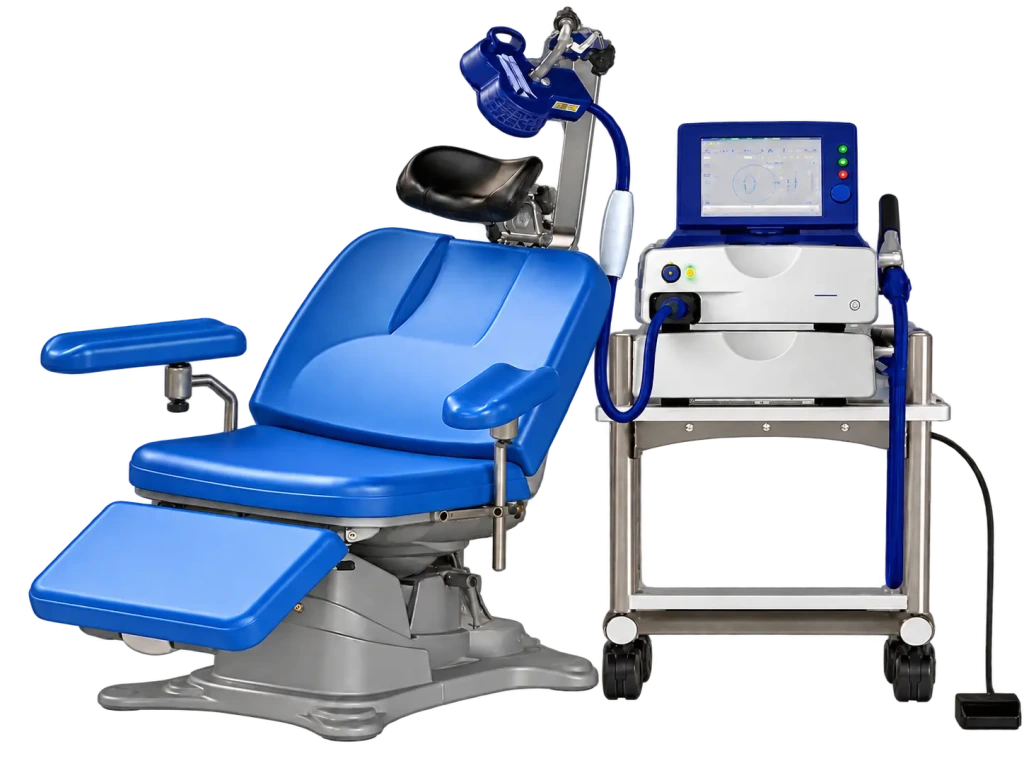
TMS (Transcranial Magnetic Stimulation) is a non-invasive brain stimulation technique used to modulate the activity of nerve cells in specific regions of the brain through magnetic pulses. It is performed without surgery by placing a specialized electromagnetic coil over the scalp.
In neurorehabilitation, TMS may be used in appropriately selected patients to modulate the excitability of brain regions associated with movement, speech, and other neurological functions and to support neuroplastic changes occurring during rehabilitation.
When magnetic pulses are delivered repeatedly according to a defined stimulation pattern, the technique is called rTMS (repetitive Transcranial Magnetic Stimulation). Parameters such as stimulation frequency, intensity, total number of pulses, and the targeted brain region can be planned according to the patient’s clinical condition and rehabilitation goals.
The purpose of TMS is not to restore a lost function on its own. Rather, it aims to modulate neural activity in targeted brain regions and help create a neurophysiological environment that may support active rehabilitation and motor learning.
For this reason, TMS may be incorporated into a comprehensive treatment program together with physiotherapy, occupational therapy, speech and language therapy, robotic rehabilitation, and other neurorehabilitation approaches.
What Is TMS?
Transcranial Magnetic Stimulation is a neuromodulation technique in which brief magnetic pulses are applied to specific regions of the brain through an electromagnetic coil positioned over the scalp.
The rapidly changing magnetic field generated by the coil passes through the skull without the need for surgery and can induce electrical activity within the targeted cortical region.
These pulses can temporarily modify the excitability of nerve cells and the activity of specific neural networks.
One of the important characteristics of TMS is its ability to target selected cortical regions.
Depending on the goals of the neurorehabilitation program, target areas may include:
- Motor regions associated with upper extremity movement,
- Motor regions associated with lower extremity movement,
- Cortical areas associated with speech and language,
- Other networks involved in motor control.
The target region, stimulation intensity, and protocol are determined according to the patient’s neurological condition and rehabilitation goals.
How Does TMS Work?
During TMS, the patient is generally seated or positioned comfortably for treatment.
The electromagnetic coil is placed over the scalp above the targeted brain region.
When the device is activated, the coil produces very brief magnetic fields. These magnetic fields can induce electrical activity in the targeted cortical area and influence the excitability of nerve cells.
A single magnetic pulse is referred to as single-pulse TMS, while repeated pulses delivered in a specific rhythm are called repetitive TMS (rTMS).
A TMS protocol may involve adjustment of:
- Stimulation intensity,
- Stimulation frequency,
- Total number of pulses,
- Session duration,
- Targeted brain region,
- Number of sessions.
These parameters are not applied identically to every patient.
An individualized plan may be developed according to the diagnosis, time since the neurological event, current functional capacity, characteristics of the neurological impairment, and rehabilitation goals.
What Is Repetitive TMS (rTMS)?
Repetitive Transcranial Magnetic Stimulation (rTMS) involves delivering repeated magnetic pulses to a selected area of the brain.
Repeated stimulation may produce neurophysiological changes in cortical excitability that can persist longer than the effects of a single magnetic pulse.
For this reason, rTMS protocols are commonly used when the aim is neuromodulation.
Different stimulation frequencies may have different effects on cortical excitability.
Some protocols are designed to facilitate activity within a targeted region, while others aim to modulate or reduce activity within specific neural networks.
However, protocol selection should not be based solely on the diagnosis.
The location of the brain injury, the patient’s current functional abilities, and the goals of treatment should all be considered.
TMS and Neuroplasticity
The brain’s ability to reorganize itself and modify neural connections following injury, disease, experience, or learning is known as neuroplasticity.
After stroke, traumatic brain injury, and other neurological conditions, one of the major principles of rehabilitation is to make effective use of this capacity for motor learning and functional adaptation.
Intensive and repetitive movement practice, task-specific exercises, and active patient participation are important principles of neurorehabilitation.
TMS offers an additional approach by modulating the excitability of specific brain regions.
For this reason, the use of TMS in neurorehabilitation is generally considered most meaningful when combined with active and functional rehabilitation exercises rather than used in isolation.
For example, TMS targeting the motor cortex may be followed by intensive training of arm, hand, or gait functions.
This approach aims to combine neuromodulation with active motor learning within the same rehabilitation program.
TMS After Stroke
After stroke, significant changes may occur in the affected brain region and in the neural networks connected to it.
The balance of activity between the two cerebral hemispheres may also be altered.
These changes may contribute to functional impairments such as:
- Arm and hand weakness,
- Reduced motor control,
- Gait impairment,
- Balance problems,
- Coordination difficulties,
- Speech and language disorders.
Depending on the patient’s clinical characteristics, motor or other functional brain regions may be targeted with TMS.
The aim is to help modulate cortical excitability and support the rehabilitation exercises performed either during the same treatment period or afterward.
TMS does not replace standard stroke rehabilitation.
In appropriately selected patients, it may be combined with physiotherapy, occupational therapy, robotic rehabilitation, gait training, or hand rehabilitation.
TMS and Upper Extremity Rehabilitation
Impairment of arm and hand function is common after stroke and brain injury.
Patients may have difficulty:
- Raising the arm,
- Controlling the elbow,
- Reaching toward an object,
- Opening and closing the hand,
- Grasping objects,
- Using the affected arm during activities of daily living.
In appropriately selected patients, cortical regions related to upper extremity motor control may be targeted with TMS as part of the rehabilitation program.
TMS may be combined with:
- Active arm exercises,
- Hand rehabilitation,
- Robotic upper extremity rehabilitation,
- Occupational therapy,
- Reaching and grasping exercises,
- Task-specific training.
The aim is not for TMS to move the patient’s arm directly.
Rather, the goal is to support the neural processes involved in motor learning and active exercise.
TMS and Lower Extremity and Gait Rehabilitation
After stroke or brain injury, impaired control of the lower extremities may affect standing, balance, and walking.
Patients may experience:
- Difficulty initiating steps,
- Reduced leg strength,
- Balance problems,
- Abnormal gait patterns,
- Reduced control of the affected leg.
TMS targeting brain regions associated with lower extremity motor control may be incorporated into rehabilitation in selected patients.
It may be combined with:
- Individual physiotherapy,
- Balance training,
- Gait training,
- Robot-assisted gait rehabilitation,
- Task-specific lower extremity exercises.
The basic principle is to combine neuromodulation of motor control networks with active movement and gait training.
TMS and Speech-Language Rehabilitation
Some patients develop aphasia after stroke or brain injury.
Aphasia may affect:
- Speaking,
- Understanding spoken language,
- Naming,
- Reading,
- Writing.
Language functions are controlled by complex neural networks involving multiple brain regions.
For this reason, TMS may be considered in neurorehabilitation to modulate activity within cortical areas associated with language functions.
In appropriately selected patients, TMS may be combined with speech and language therapy.
The goal is not to replace speech therapy, but to support neuromodulation of the neural networks targeted during language rehabilitation.
TMS and Spasticity
Spasticity and increased muscle tone may develop after stroke, brain injury, and other central nervous system disorders.
Spasticity is not simply a local problem within the muscles.
It is a complex neurological condition resulting from changes in motor control mechanisms within the brain and spinal cord.
TMS aimed at modulating the motor cortex and motor control networks may be considered as one component of comprehensive spasticity rehabilitation in selected patients.
However, TMS does not replace other spasticity treatments such as:
- Physical therapy,
- Stretching,
- Positioning,
- Orthoses,
- Botulinum toxin injections,
- Medication,
- Functional rehabilitation.
Treatment should be individualized according to the severity of spasticity, active movement capacity, and functional goals.
What Is the Motor Threshold in TMS?
One of the important parameters that may be assessed when individualizing TMS is the motor threshold.
When a specific region of the motor cortex is stimulated, a motor response may be produced in muscles on the opposite side of the body.
This response can provide information about cortical excitability.
The motor threshold may then be used as a reference when determining stimulation intensity.
This allows treatment parameters to be based not only on a standard device setting but also on the patient’s individual neurophysiological characteristics.
What Does a Patient Feel During TMS?
TMS is not a surgical procedure and does not require general anesthesia.
The patient remains awake during treatment.
During magnetic stimulation, the patient may experience:
- A mild tapping or touching sensation on the scalp,
- Rhythmic clicking sounds from the device,
- Temporary scalp discomfort,
- Brief contractions of facial or scalp muscles.
Some patients may experience temporary headache or scalp tenderness after treatment.
Appropriate hearing protection may be used because of the sound generated by the device.
How Is TMS Treatment Planned?
Before TMS is performed, the patient’s medical and neurological condition should be evaluated in detail.
Assessment may include:
- Diagnosis,
- Type of brain injury,
- Location of the injury,
- Time since the neurological event,
- Motor function,
- Muscle strength,
- Muscle tone,
- Speech and cognitive function,
- Current medications,
- History of seizures,
- Implanted devices,
- Previous treatments,
- Rehabilitation goals.
The main purpose of treatment is then identified.
For one patient, supporting arm and hand function may be the priority, while for another, gait, balance, language, or another neurological function may be targeted.
Based on this assessment, the targeted brain region, stimulation intensity, and treatment protocol are selected.
Clinical response and functional progress are monitored throughout treatment, and the rehabilitation program may be adjusted when needed.
How Many TMS Sessions Are Needed?
There is no single standard number of TMS sessions that applies to every patient.
The number and duration of sessions may vary according to:
- Diagnosis,
- Stage of the condition,
- Purpose of treatment,
- Stimulation protocol,
- Clinical response,
- Concurrent rehabilitation program.
In some treatment programs, TMS may be administered over a series of consecutive treatment days.
The number of sessions should therefore be determined according to the initial assessment and the patient’s clinical response during treatment.
Who May Be Suitable for TMS?
The potential role of TMS varies according to the diagnosis and clinical characteristics of the patient.
Within neurorehabilitation, it may be considered in selected patients with different neurological conditions.
Stroke
Post-stroke motor impairment is one of the areas in which TMS has been most extensively investigated in neurorehabilitation.
In appropriately selected patients, particularly those with upper extremity impairment, motor cortex stimulation may be incorporated into a comprehensive rehabilitation program.
The aim is to support active motor training and functional rehabilitation.
Traumatic Brain Injury
Traumatic brain injury caused by traffic accidents, falls, or other trauma may result in:
- Reduced muscle strength,
- Coordination problems,
- Impaired motor control,
- Cognitive difficulties,
- Dependence in activities of daily living.
In selected patients, TMS may be considered as part of a comprehensive neurorehabilitation program.
Because seizure risk may be increased in some patients with traumatic brain injury, neurological history and individual risk factors should be carefully assessed before treatment.
Anoxic Brain Injury
Anoxic brain injury caused by insufficient oxygen supply to the brain may result in motor, cognitive, and functional impairments.
The suitability of TMS in these patients should be evaluated individually according to neurological status and rehabilitation goals.
Aphasia and Language Disorders
In patients with speech and language disorders following stroke or certain brain injuries, TMS may be considered in combination with speech and language therapy.
The targeted brain region and stimulation protocol should be selected according to the characteristics of the language impairment.
Other Neurological Conditions
TMS is being studied in a variety of neurological conditions.
However, the same protocol should not be used automatically for every neurological disorder.
Treatment decisions should be based on the patient’s neurological and functional status rather than diagnosis alone.
What Are the Goals of TMS in Neurorehabilitation?
Depending on the patient’s clinical condition, TMS may be used with the aim of:
- Modulating cortical excitability,
- Supporting neuroplastic processes,
- Supporting motor learning,
- Helping create a neurophysiological environment favorable to active rehabilitation,
- Supporting upper extremity rehabilitation,
- Supporting lower extremity and gait rehabilitation,
- Supporting motor control training,
- Supporting speech and language rehabilitation in appropriately selected patients,
- Combining neuromodulation with other rehabilitation technologies.
Because rehabilitation goals differ between patients, TMS should also be individualized.
What Are the Advantages of TMS?
Non-Invasive Brain Stimulation
TMS does not require surgery.
Magnetic stimulation is delivered through the scalp without placing electrodes or devices inside brain tissue.
Ability to Target Specific Brain Regions
By appropriately positioning the electromagnetic coil, selected cortical regions can be targeted according to rehabilitation goals.
Individualized Stimulation Parameters
TMS parameters such as:
- Stimulation intensity,
- Frequency,
- Number of pulses,
- Targeted brain region,
- Session duration
can be adjusted according to the protocol and the individual characteristics of the patient.
Can Be Combined with Active Rehabilitation
One of the important advantages of TMS in neurorehabilitation is that it can be integrated with active treatments such as physiotherapy, occupational therapy, speech and language therapy, and robotic rehabilitation.
No General Anesthesia Required
Treatment is generally performed while the patient is awake.
No general anesthesia or surgical procedure is required.
Is TMS Safe?
TMS is generally considered a well-tolerated, non-invasive stimulation technique when appropriate patient selection and established safety protocols are followed.
However, as with any medical intervention, side effects may occur.
These may include:
- Headache,
- Scalp tenderness,
- Discomfort at the stimulation site,
- Temporary facial muscle contractions,
- Dizziness.
Serious adverse effects are uncommon, but seizures are an important potential risk that must be considered when planning TMS.
For this reason, a detailed medical and neurological history should be reviewed before treatment.
Who May Not Be Suitable for TMS?
Electronic or metallic implants should be carefully assessed before TMS.
Particular attention may be required in patients with:
- Cochlear implants,
- Implanted brain stimulation systems,
- Deep brain stimulation devices,
- Certain neurostimulators,
- Certain metallic implants in or near the head,
- Aneurysm clips or similar implants,
- Implanted electronic devices.
Other factors that should be considered include:
- History of seizures,
- Epilepsy,
- Certain medications,
- Previous neurological conditions,
- Overall medical status.
The presence of a metallic or electronic implant does not automatically mean that TMS can never be performed.
The type, location, and characteristics of the implant must be evaluated by the treating physician.
Is TMS Sufficient as a Stand-Alone Treatment?
No.
TMS does not replace the entire neurorehabilitation process.
Depending on the patient’s needs, TMS may be combined with:
- Individual physiotherapy,
- Occupational therapy,
- Robotic rehabilitation,
- Hand and upper extremity rehabilitation,
- Gait training,
- Balance and coordination exercises,
- Functional Electrical Stimulation,
- Speech and language therapy,
- Activities of daily living training.
For example, a patient with arm and hand impairment may undergo robotic upper extremity rehabilitation or intensive functional arm and hand exercises after TMS.
For another patient with impaired walking function, TMS may be combined with individual physiotherapy and robot-assisted gait rehabilitation.
The principle is to combine neuromodulation with active functional training within the same rehabilitation program.
Can TMS and Robotic Rehabilitation Be Used Together?
TMS and robotic rehabilitation work through different mechanisms but may complement each other in appropriately selected patients.
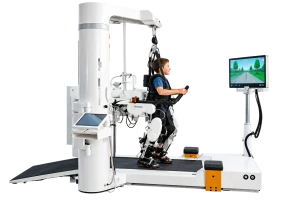
TMS is used to modulate cortical excitability in targeted brain regions, while robotic rehabilitation provides intensive, controlled, and repetitive movement training.
For this reason, combined programs may include:
TMS + individual physiotherapy + robotic rehabilitation
Depending on the patient’s needs, TMS may be followed by:
- Robot-assisted gait training,
- Robotic upper extremity rehabilitation,
- Hand rehabilitation,
- Active physiotherapy,
- Functional task training.
The aim is not to use as many technologies as possible, but to match the right treatment to the right patient and the right rehabilitation goal.
Why Is Individualized Planning Important in TMS Treatment?
Two patients with the same diagnosis may have very different neurological and functional impairments.
For example, two patients who have experienced a stroke may differ in:
- Location of the brain injury,
- Size of the affected area,
- Time since stroke,
- Body region affected,
- Active movement capacity,
- Muscle strength,
- Muscle tone,
- Cognitive status,
- Independence in daily activities,
- Rehabilitation goals.
For this reason, applying exactly the same TMS protocol to every patient is not appropriate.
The targeted brain region, stimulation parameters, treatment schedule, and rehabilitation methods combined with TMS should be determined after individual assessment.
What Is the Goal of Rehabilitation with TMS?
The goal of neurorehabilitation with TMS is not simply to deliver magnetic stimulation to selected areas of the brain.
The broader aim is to support the brain’s processes of relearning and reorganization according to the patient’s neurological condition and functional capacity, and to combine neuromodulation with intensive, repetitive, and active rehabilitation.
While TMS may help modulate excitability within targeted brain regions, physiotherapy, occupational therapy, speech and language therapy, and robotic rehabilitation allow the patient to actively practice movements and functional tasks.
For this reason, treatment outcomes depend not only on the application of TMS itself, but also on how appropriately it is integrated into a comprehensive rehabilitation program based on the patient’s individual goals.
At Acıbadem Healthcare Group, TMS may be planned as part of a comprehensive neurorehabilitation program after assessment of the patient’s medical condition, neurological impairment, current functional capacity, and individual rehabilitation goals.
Through advanced rehabilitation technologies, intensive individualized treatment, and a multidisciplinary approach, the aim is to integrate TMS with active rehabilitation in appropriately selected patients and support motor, functional, and neurological recovery.